
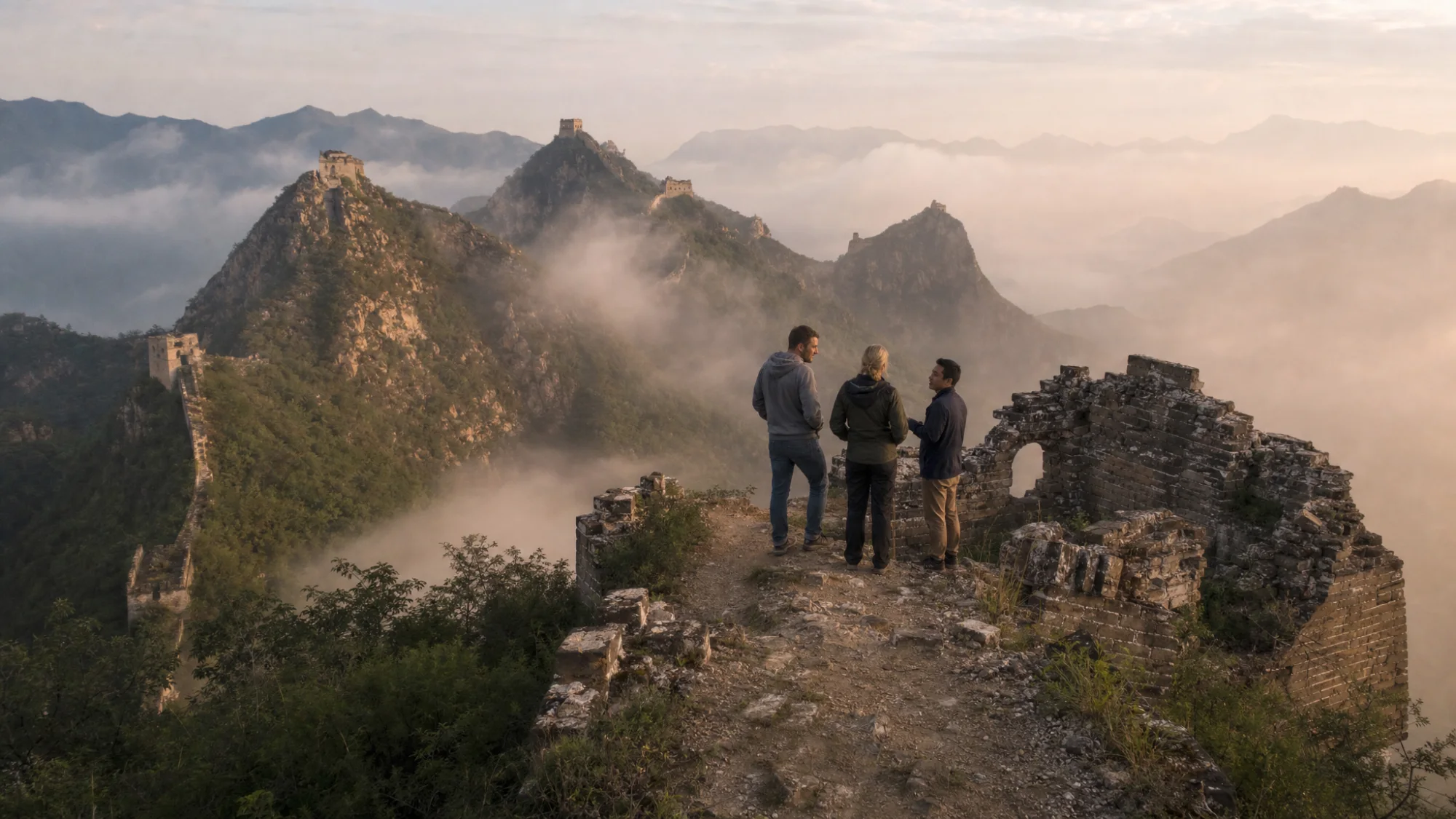
Choose Mutianyu if you want easier logistics, a shorter outing, or are traveling with children or anyone who prefers a more developed visitor experience. Choose Jinshanling if the Great Wall is a major reason for your Beijing trip and you want quieter ridges, longer walking, and more time to understand the Wall as a landscape rather than a single landmark.
I am sometimes asked which Great Wall section is “best.” That question sounds simple, but it hides the decision that actually matters: what kind of day will suit the people traveling?
Mutianyu and Jinshanling are both worthwhile. I would not send every guest to Jinshanling, even though it is the section I use for my own Beyond the Great Wall day. Mutianyu can be the more intelligent choice when convenience, limited time, or family logistics matter most. Jinshanling earns the longer journey when you want the Wall itself—not just a photograph of it—to shape the day.
Jinshanling vs Mutianyu at a glance
| Question | Mutianyu | Jinshanling |
|---|---|---|
| Best for | First-time visitors who value convenience, families, mixed mobility, and shorter schedules | Walkers, photographers, history-minded travelers, and guests who want a quieter full day |
| Travel from Beijing | Closer and generally easier to fit into a shorter day | Farther away; worth treating as the main purpose of the day |
| Crowd feeling | Popular and busier, especially at the main access points | Usually quieter, with more space between walking groups |
| Walking | Easier to adapt around a shorter route, though steep steps remain | More varied and sustained; uneven sections and exposed ridges ask for honest pacing |
| Character | A strongly restored, impressive section with developed visitor facilities | A changing mix of restored and weathered Wall across a broad mountain landscape |
| Time to allow | Works well as a half-day or part of a broader day | Best given a full day from Beijing |
Important: access arrangements, opening hours, cable-car operations, and trail conditions can change. Confirm current conditions close to your visit rather than building the day around a single facility or fixed walking route.
Choose Mutianyu when ease matters most
Mutianyu is a very good Great Wall introduction. It is closer to Beijing than Jinshanling, its visitor infrastructure is more developed, and it is easier to build a day that does not demand prolonged walking. That matters when you have young children, limited time, uncertain weather, or a group with different energy levels.
The Wall here is heavily restored. Some travelers treat that as a disadvantage, but it can also make the structure easier to read at first glance: crenellations, towers, steps, and the line across the mountains are immediately clear. The landscape is still dramatic, and going early or choosing the day carefully can make the experience much calmer than its popularity suggests.
Mutianyu is probably right for you if:
- You have only half a day available for the Great Wall.
- Your group includes young children or travelers who want flexible walking.
- You value predictable facilities and straightforward access.
- You want a strong first impression without making the Wall the entire day.
Choose Jinshanling when the Wall deserves the day
Jinshanling asks for more. The drive is longer, the terrain is more varied, and the day makes most sense when you do not rush back toward another major sight. In return, the Wall opens out across a much larger visual field. Towers answer one another along the ridges. Restored stretches meet sections that show age, repair, and weather. The mountain becomes part of the explanation.
This is why I prefer Jinshanling for travelers who are curious about more than the monument’s outline. Standing inside a tower, you can talk about sightlines, signals, shelter, supply, and the physical work of building on steep ground. Walking between towers makes distance tangible. The Wall begins to feel like a system designed around terrain and people.
Quiet is not guaranteed—no famous place offers that promise—but Jinshanling usually gives the day more breathing room. On the right day, you can stop without feeling pushed onward by the flow behind you. That pause changes what you notice.
Jinshanling is probably right for you if:
- The Great Wall is one of the main reasons you came to Beijing.
- You enjoy walking and are comfortable with uneven steps and changing gradients.
- You care about landscape, photography, frontier history, or architectural detail.
- You would rather see fewer places well than add another landmark to the afternoon.
What the comparison table cannot decide
A destination name is only one part of a good day. Season, temperature, visibility, holiday traffic, knee comfort, fear of heights, and how well the group walks together can matter more. A confident hiker in cool weather and a family visiting during summer heat should not receive the same recommendation.
I also avoid promising a particular tower, distance, cable car, or sunset in advance. Current access and weather must be checked, and the route should remain responsive to the people actually walking it. A shorter line with time to look can be far better than completing a planned distance after the day has stopped being enjoyable.
My honest recommendation
If this is your first Beijing visit, you have limited time, and you mainly want a beautiful Great Wall experience, choose Mutianyu without feeling you have settled for second best. It is popular because it solves many practical problems well.
If the Great Wall is central to your trip, you enjoy walking, and you want the landscape to have time to unfold, choose Jinshanling. Leave the rest of the day open. The longer road is justified only when you allow the place to become the day, rather than treating it as a distant photo stop.
That is also the reasoning behind my private Jinshanling experience: the route is shaped around the mountain, current conditions, and the people walking—not around the number of towers completed.
Frequently asked questions
Is Jinshanling better than Mutianyu?
Neither is better for everyone. Jinshanling is usually the stronger choice for quieter ridges, longer walking, and a more varied historic landscape. Mutianyu is usually better for easier access, family logistics, and a shorter Great Wall visit.
Which section is less crowded?
Jinshanling generally feels quieter because it is farther from central Beijing and receives fewer short-stay visitors. Crowd levels at either section still depend on the day, season, weather, and holiday calendar.
Which section is easier for families?
Mutianyu is usually the simpler family choice because the visitor infrastructure is more developed and the outing can be shaped around a shorter walk. Jinshanling suits families whose children enjoy walking and whose group is comfortable with a longer day.
Can older travelers visit Jinshanling?
Some older travelers enjoy Jinshanling very much, but age alone is not the useful test. Knee comfort, balance, heat, confidence on uneven steps, and the group’s preferred pace matter more. The route should be adjusted to the actual traveler and current conditions.
How should I choose if I still cannot decide?
Choose Mutianyu when convenience and a shorter, more predictable visit matter most. Choose Jinshanling when the Great Wall is a major reason for your trip and you want to give the landscape most of a day.