
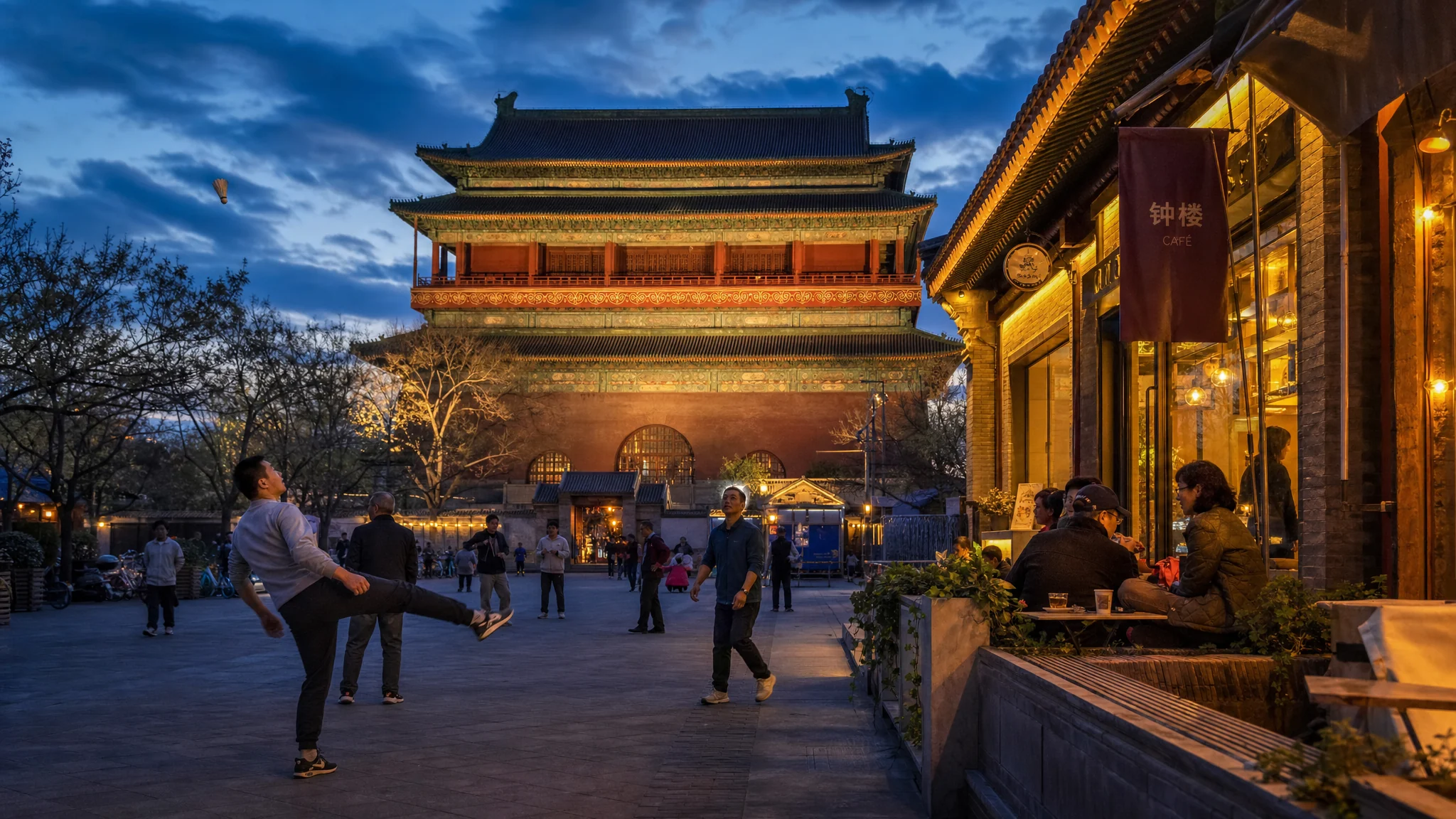
For a short first visit built around the historic city, start with actual hotels around Wangfujing–Dengshikou or Qianmen–Chongwenmen. Then choose the better entrance, daily journeys and evening surroundings—not the pin closest to the words “city centre.” If neighborhood evenings matter more than landmark proximity, compare Gulou and the hutong areas too. If contemporary dining and shopping are the point, Sanlitun may suit you better.
These are planning recommendations, not a ranking of hotels. A good room on the right street can be more useful than a fashionable district with an awkward last stretch.
Choose for the days you will repeat, not one exceptional journey
Write down your three main daytime destinations, what you want within reach after dinner, and the journey with a non-negotiable deadline. A four-night stay with several city days and one early train should not automatically become four nights beside the railway station. Equally, a late arrival followed by an early departure may be a transfer problem rather than a sightseeing-base problem.
Before choosing a district, count your full usable days. On a short visit, repeatedly crossing town can matter more than the apparent saving on a room. But “central” does not eliminate travel: your chosen Wall section and the Summer Palace still need their own route planning.
Four starting points, with the trade-offs left in
| Area to compare | A useful fit when… | Check before committing |
|---|---|---|
| Wangfujing / Dengshikou | You want a central eastern base and a choice of hotels, shops and places to eat | The actual street, station entrance and room position; a commercial-area address is not a promise of quiet or a short walk to every attraction |
| Qianmen / Chongwenmen | You want to include the southern old-city streets in your evenings and daily plan | Pedestrian streets, the final luggage walk and the precise pickup point; nearby hotels can have quite different access |
| Gulou / Shichahai / nearby hutongs | Neighborhood wandering is a priority rather than a spare hour between monuments | The specific lane and room: quiet, vehicle access, stairs and facilities cannot be inferred from “courtyard hotel” |
| Sanlitun | Contemporary shopping, restaurants and evenings are a major part of your trip | The journeys back from your historical sights and the late-night surroundings of the exact hotel |
The Beijing municipal commercial-area directory distinguishes Wangfujing, Qianmen–Dashilan and Sanlitun as different shopping districts. That helps describe the setting, not certify any hotel's convenience, price or quality. The suitability judgments above are editorial advice; current walking routes and individual properties need checking.
Three situations that change the answer
A first visit with three full city-and-Wall days
Start with a practical central hotel shortlist, not a long list of districts. Check the route to your reserved museum visit, the exact meeting point for your Wall day and somewhere easy for dinner on the flexible city day. Eliminate a hotel if it makes two of those harder merely to make one journey slightly shorter. A public bus pickup and a private hotel pickup are different arrangements: use the meeting point on the actual booking.
A week where food and everyday streets matter most
Give more weight to what happens outside the hotel after sightseeing. Compare a hutong-area stay with an eastern central-city hotel on a less commercial street. If contemporary restaurants and shopping are what you actually want, include Sanlitun rather than choosing an old-city address out of obligation. You can visit a neighborhood without sleeping in it; the question is which surroundings you want repeatedly.
Children, tired knees or large suitcases
Put access ahead of romance. Ask where a car can stop, how far luggage must be carried, whether every part of the route to the room is step-free, and whether a lift reaches the booked floor. Ask about the exact room's beds, bathroom, heating or cooling and any courtyard-facing noise. Do not assume that a large hotel is fully accessible or that a small courtyard hotel is difficult: get property-specific answers.
“Near the Forbidden City” is not an entrance plan
A hotel can be close to a palace wall without being close to the route you need. The Palace Museum's official visitor guidance identifies the Meridian Gate (Wu men) as the entrance and distinguishes the exit gates. That notice is from 2024; use the current official visit information to recheck arrangements for your date. Do not treat an old forum claim about entering through the east gate as booking advice.
On your map, use the hotel's real entrance and the permitted visitor approach—not the middle of the museum grounds. Check the return route separately. The same principle applies to stations: the station name is not a substitute for the entrance and meeting point you will use with bags.
Should you stay near the station or airport?
Compare the whole stay before optimizing the departure morning. For several sightseeing days, first investigate an early transfer from the hotel you would otherwise choose. Ask for pickup time, exact destination, confirmation and a fallback contact. Do not rely on a claim that a car is always available immediately, and do not assume the first metro will meet your check-in or boarding deadline.
A transit-focused last night can still be sensible if it reduces a risk you care about. Count the cost of packing, checking out, travelling, storing bags and checking in again. For an airport hotel, confirm the airport and terminal, actual shuttle hours, reservation requirement and luggage handling; the words “airport hotel” alone do not settle the transfer. This guide deliberately gives no universal journey time or hotel rate.
A six-question hotel check you can copy
- Exact identity: What are the Chinese name, full address and entrance pin of this branch?
- Last stretch: Where can a taxi stop, how far must we carry bags, and are there steps?
- Daily use: Which station entrance and walking route would we actually use? Test routes to our three priorities, not just the nearest landmark.
- The booked room: What beds, bathroom, window, heating/cooling and noise exposure does this room have? Check recent reviews of the same room category where possible.
- Arrival and departure: Can reception handle our arrival time, store luggage, and confirm any early transfer? Is early room access guaranteed or merely requested?
- Booking terms: What is the final payable amount, cancellation deadline and deposit or payment arrangement? Obtain written confirmation of any essential requirement before a non-refundable booking.
For international guests, also confirm the check-in document requirements with the property. Beijing's official accommodation-registration guide says hotel staff handle registration at check-in; non-hotel accommodation has a different registration process. Do not assume an apartment listing will handle it in the same way. Requirements were checked on 3 November 2026; use the official guidance for your circumstances.
If you want the hotel area and itinerary considered together
Beijing, Beyond a Single Day includes hotel-area recommendations within stay design. Its starting service includes two hosted days, not a host for every day of a longer visit. Hotels and other third-party costs are separate. You can also plan independently using the checks above. If a coordinated stay would help, send your dates, hotel shortlist and priorities through the Stay Design Note; the agreed scope belongs in the final written confirmation.
Frequently asked questions
What is the best area to stay in Beijing for a first visit?
For a short, sightseeing-led first visit, start by comparing actual hotels around Wangfujing and Dengshikou with Qianmen and Chongwenmen. Choose the hotel whose entrance, routes and evening surroundings fit your plans; no single area wins for everyone.
Is Wangfujing or Qianmen better?
Wangfujing suits an eastern central-city base with shopping and hotel options. Qianmen suits travelers drawn to the southern old-city streets. Compare your specific hotel and daily journeys, not just the neighborhood names.
Should I stay beside Beijing West station for an early train?
Not automatically. Compare the cost and disruption of moving hotels with a confirmed early transfer from your sightseeing base. A transit-focused final night can make sense when the departure risk matters more than another evening in the city.
Is a hutong hotel suitable with children or heavy luggage?
It can be, but check the exact vehicle meeting point, luggage carry, stairs or lift, room arrangement, heating or cooling and noise. Courtyard atmosphere does not establish accessibility or room comfort.
Does a hosted Beijing stay include the hotel?
No. The starting Beijing, Beyond a Single Day service includes two hosted days, not accommodation or a host on every day of your trip. Confirm the final scope in writing; hotel costs are separate.